Goats Stock For Sale In Mountain Goats Farm
Are you looking for a Goat meat or stock in, then Contact Mountain Goats Farm today.
Our herd produces white and silver cashmere. Goats are bred to kid in February and March and are usually weaned at around three months. With access to fresh water, high-quality hay, occasional grain supplements during extreme cold or kidding season, and mineral supplementation, our goats thrive in the Midwest climate.
Cashmere goats are a type rather than a formal breed, but they must meet specific physical and fiber standards.
The demand for cashmere, the fine undercoat of these goats, has always exceeded supply. Cashmere is prized for its softness, warmth, durability, and light weight, making it one of the most exotic and sought-after fibers for garments.
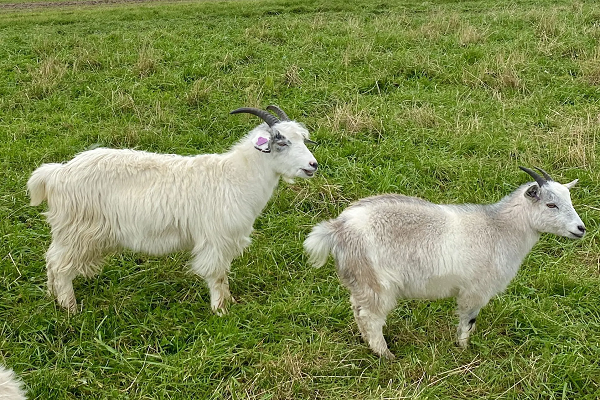
Stud Ewes
To be considered a “stud-grade” Cashmere doe, the animal must meet strict international or regional fiber standards:
- Mean Fiber Diameter (MFD): The undercoat (down) must be extremely fine, typically 19 microns or less.
- Total Down Weight (TDW): A productive doe should yield between 4 and 6 ounces (114–170g) of clean fiber annually. Exceptional individuals, such as certain Inner Mongolian strains, can produce significantly more.
- Crimp and Style: Fibers must exhibit a three-dimensional, irregular crimp (style) along their entire length to ensure the resulting yarn is elastic and soft.
- Fiber Coverage: “Complete cover” is required, meaning quality cashmere grows consistently on the neck, shoulder, side, and hip.
- Mean Fiber Diameter (MFD): The undercoat (down) must be extremely fine, typically 19 microns or less.
Physical Characteristics (Conformation)
Standard breeding does are dual-purpose animals, often providing meat (chevon) as well as fiber.
- Hardiness: They are bred to be sturdy and resilient, capable of thriving in harsh climates with minimal human intervention.
- Frame: Does typically stand 24 to 30 inches tall and weigh between 50 and 100 pounds (22–45 kg).
- Maternal Ability: Breeding does are selected for strong maternal instincts; they often give birth to 1–3 kids and raise them without assistance.
- Udder Quality: Unlike dairy goats, Cashmere does have small, high-attached udders designed to avoid injury in rugged terrain.
Stud Buck
A stud-grade buck is primarily judged on the quality and quantity of his underdown (cashmere):
- Fineness: The fiber must have a mean fiber diameter of 19 microns or less.
- Yield: An adult buck typically produces more fiber than a doe, often yielding up to 2.5 pounds of raw fleece annually.
- Crimp & Style: High-quality bucks exhibit a three-dimensional, irregular crimp along the entire fiber length, which provides elasticity and softness to the final product.
- Differentiation: There must be a clear distinction between the coarse outer “guard hair” and the soft cashmere undercoat so they can be easily separated during processing.
Physical Characteristics (Conformation)
Standard breeding bucks are typically dual-purpose, valued for meat as well as fiber.
Masculinity: A stud buck should have a rugged, masculine appearance with a well-developed head and a thick, muscled neck and chest.
Masculinity: A stud buck should have a rugged, masculine appearance with a well-developed head and a thick, muscled neck and chest.
- Frame & Weight: While sizes vary by strain, adult bucks generally weigh between 100 and 200 lbs (45–90 kg) and stand roughly 26 to 30 inches tall at the shoulders.
- Horns: Most breeders prefer horned bucks, as horns help dissipate heat. They typically grow in a spectacular “handlebar” sweep outward and back.
- Structural Soundness: They must have strong, straight legs and sturdy hooves to navigate rugged terrain and remain mobile during the breeding season.
Reproductive Health
- Testicles: A breeding buck should have two large, symmetrical, and well-descended testicles. Scrotal circumference is a key indicator of fertility and should be at least 25 cm in a mature adult.
- Temperament: A good stud buck should be assertive and aggressive in his mating behavior but manageable for the handler.
- Odor: Interestingly, some breeders note that Cashmere bucks often have less offensive “rut odor” compared to dairy breeds if kept in clean, outdoor conditions.